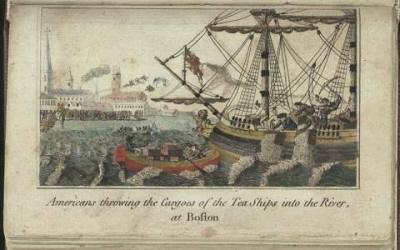
Let’s take a glimpse on how this all began in the early days; Long before the ‘Declaration of Independence’… In Boston…
The Boston Tea Party: The Night 342 Crates of Tea Sparked a Revolution
Discover the history behind the Boston Tea Party. Learn why American colonists dumped 92,000 pounds of tea into Boston Harbor and how it sparked the Revolutionary War.
On the cold night of December 16, 1773, a group of American colonists boarded three British merchant ships in Boston Harbor. In just three hours, they dumped 342 chests of tea into the dark waters. This act of defiance, known today as the Boston Tea Party, was not a lawless riot, but a meticulously organized political protest.
It became the catalyst that united thirteen divided colonies and set them on an irreversible path toward the American Revolutionary War.
Here is the story of how a dispute over tea changed the course of world history.
The Root Cause: “No Taxation Without Representation”
To understand why the colonists targeted tea, we have to look at the aftermath of the French and Indian War (1754–1763). The war left the British Empire heavily in debt. Believing the American colonies should help pay for their own defense, the British Parliament passed a series of taxes on goods imported by the colonists, including stamp duties, paper, glass, and tea.
The colonists were furious—not necessarily because the taxes were high, but because of the principle. They had no elected representatives in the British Parliament. Under the British Constitution, they argued, citizens could not be taxed without their consent. Their rallying cry became: “No taxation without representation!”
While Britain eventually repealed most of these taxes due to colonial boycotts, they kept the tax on tea to assert their sovereign authority.
The Monopoly That Sparked the Fuse
In May 1773, Parliament passed the Tea Act. This law granted a financial lifeline and a monopoly on the American tea trade to the struggling British East India Company.
The act allowed the company to sell tea directly to the colonies at a price cheaper than local colonial merchants and even Dutch smugglers could manage. However, the hated Townshend tax on tea remained.
The colonists saw this as a corporate bailout and a trap to force them to acknowledge Parliament’s right to tax them. When three East India Company ships—the Dartmouth, the Eleanor, and the Beaver—arrived in Boston Harbor in late 1773, the stage was set for a showdown.
December 16, 1773: The Night in the Harbor
The Royal Governor of Massachusetts, Thomas Hutchinson, refused to let the ships leave without paying the tax. Meanwhile, the colonists, led by a patriot political group called the Sons of Liberty, refused to let the tea be unloaded.
On the evening of December 16, thousands of citizens gathered at the Old South Meeting House. When word arrived that the Governor would not back down, patriot leader Samuel Adams reportedly gave a signal.
A large group of men—many thinly disguised in Native American dress to hide their identities and symbolize their independence from Britain—marched down to Griffin’s Wharf.
The protest was remarkably disciplined and quiet:
- The Damage: Armed with axes, the men boarded the three ships, smashed open 342 heavy chests, and dumped their contents into the harbor.
- The Scale: They destroyed roughly 92,000 pounds of tea, worth roughly $1 million to $1.7 million in today’s currency.
- The Restraint: No one was harmed, no property other than the tea was damaged, and the men even swept the decks clean before leaving.
The Aftermath: The Road to Revolution
The British government, led by King George III and Prime Minister Lord North, was outraged by the destruction of property. In 1774, Parliament retaliated by passing the Coercive Acts, which the colonists renamed the Intolerable Acts.
These harsh punitive measures:
- Closed Boston Harbor completely until the tea was paid for.
- Stripped Massachusetts of its right to self-governance.
- Forced colonists to house British troops in unoccupied buildings.
Britain intended for these laws to punish Massachusetts and isolate it from the other colonies. Instead, the strategy backfired completely. The sister colonies viewed the punishment as tyrannical and rushed to send food and supplies to blockaded Boston.
The shared outrage united the thirteen colonies for the first time. In September 1774, delegates met at the First Continental Congress to coordinate their resistance. Just seven months later, in April 1775, the “shot heard ’round the world” was fired at Lexington and Concord, officially beginning the American Revolutionary War.
Quick Facts for Your Next Trivia Night:
The harbor smelled for weeks: The sheer volume of tea leaves fermenting in the shallow, cold water created a massive stench over Boston for days.!
It wasn’t called the “Boston Tea Party” at first: For decades after the event, it was referred to strictly as “the destruction of the tea.” The phrase “Boston Tea Party” didn’t catch on in print until the late 1820s.
They didn’t drink English tea: The tea destroyed was actually Chinese tea, imported to London by the East India Company before being shipped to America.
*Picture above is of a 1789 engraving depicting the Boston Tea Party. Source: NCpedia
Leave a Reply